


| Date | Event |
|---|---|
| 15th March 2026 | Early-bird registration and abstract submission opens |
| 12th July 2026 | Abstract submission closes |
| 31st July 2026 | Notification of decisions regarding abstract submission |
| 31st July 2026 | Early-bird registration closes |
| 10th October 2026 | Publication of the official program and schedule |
| 1st November 2026 | General registration closes |
| 25th November 2026 | Conference begins |
| 27th November 2026 | Conference ends |
¡Bienvenidos & Bem-vindos!
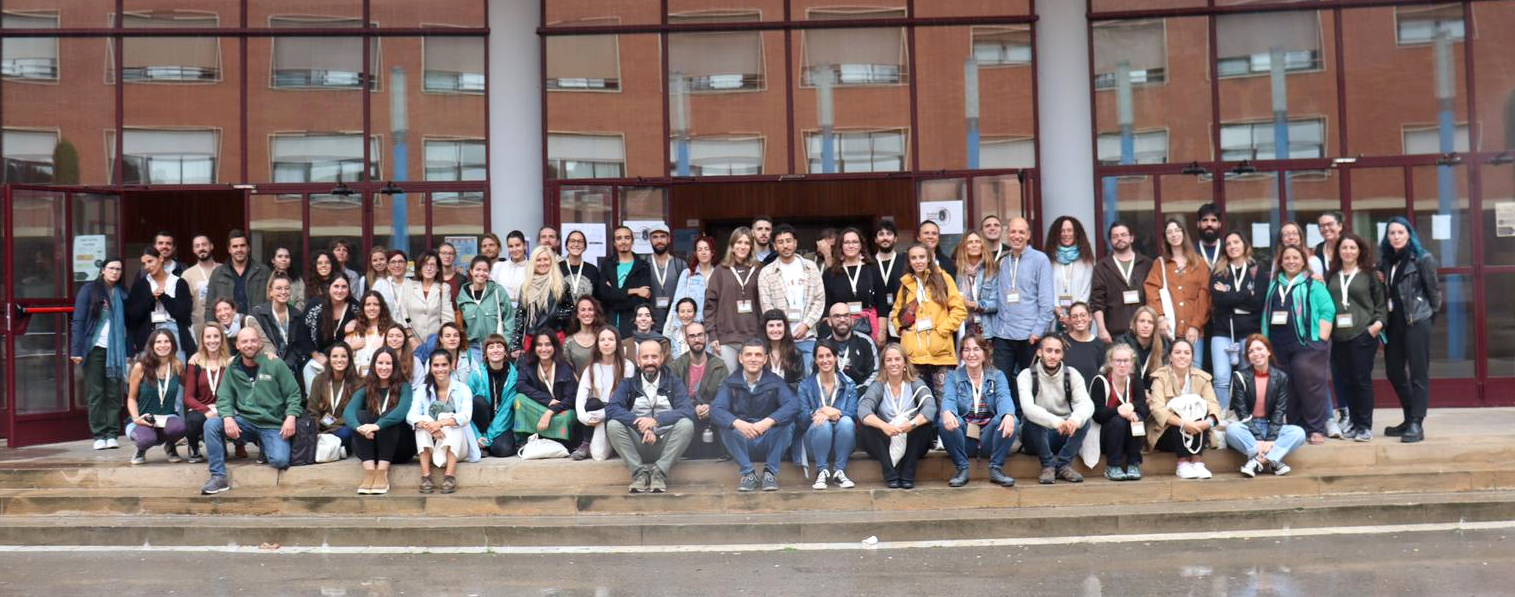
VIII Iberian Primatology Conference
Welcome to the 10th Iberian Primatology Conference, which will take place in Madrid from November 25 to 27.
Following the inspiring conference hosted by our Portuguese colleagues last year, it is now Spain’s turn to welcome the Iberian primatology community once again. We are delighted to invite students, researchers, and professionals interested in primatology to spend three stimulating days together in the capital of Spain.
This year’s meeting takes place at an important moment for the field, with evolving legal frameworks and increasing societal attention regarding the status and welfare of great apes and other non-human primates under human care. We hope this conference will serve as a space to bring together and UNITE the diverse professionals and institutions dedicated to studying, protecting, and caring for these remarkable animals.
Advances in research continue to deepen our understanding of primate behavior, cognition, welfare, and conservation. By sharing knowledge and experiences, we strengthen our collective ability to improve the care of primates living in human-managed environments while also supporting conservation efforts across the Iberian Peninsula and in primate range countries.
Events like the Iberian Primatology Conference provide an invaluable opportunity for students and professionals from universities, zoological institutions, rescue centres, sanctuaries, and NGOs to connect, exchange ideas, and build collaborations that will benefit primates in the long term.
Madrid offers a central meeting point for our community, and we look forward to welcoming participants from across Spain, Portugal, and beyond.
We would like to sincerely thank everyone who made this conference possible: the organizing and scientific committees, the many students and colleagues contributing presentations and posters, and Faunia for hosting us in the exceptional NaturActiva conference space.
We look forward to meeting many of you once again and to welcoming others for the first time. We wish you an inspiring and rewarding conference. If you have any questions, please do not hesitate to contact us.
See you soon in Madrid!
Ana Fidalgo,
Presidenta de la APE
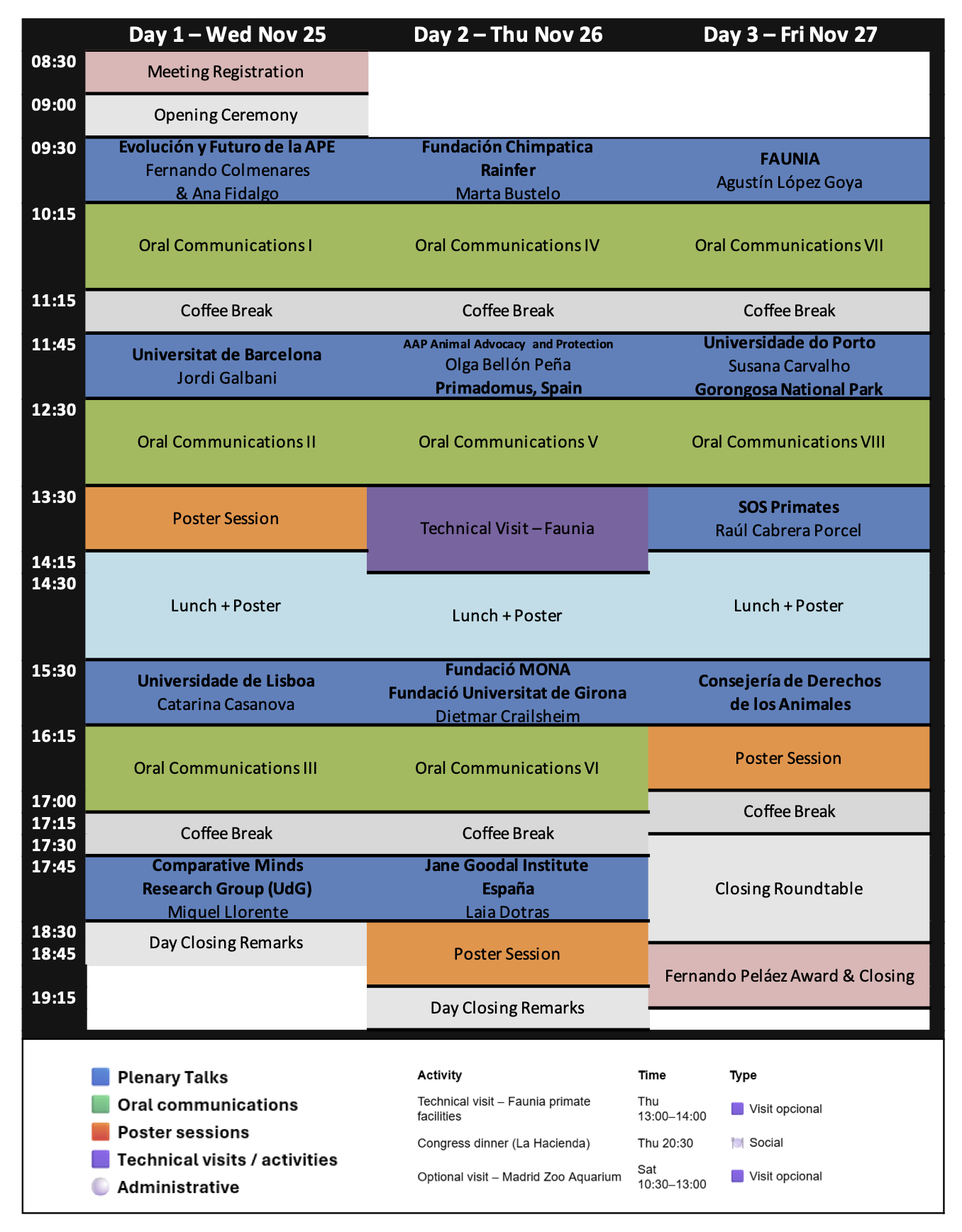
Schedule & Scientific Programme
Conference Schedule
This year, the focus of the conference is not primarily on individual invited speakers, but rather on representing the wide range of professional institutions that work tirelessly to care for and protect primates, both in captivity and in their natural habitats.
Each plenary session will therefore be dedicated to a specific type of institution—such as research groups, husbandry institutions, zoos, rescue and rehabilitation centers, and NGOs—in order to ensure that the many different perspectives, areas of expertise, and knowledge bases within primatology are represented. This structure provides an opportunity for these institutions to present their most recent findings and contributions to the field.
Participants can look forward to drawing on decades of accumulated knowledge and experience shared by professionals from diverse disciplines. Presentations will cover a broad spectrum of topics, including research, animal care and husbandry, health and veterinary science, public awareness and education, rescue and rehabilitation, and both ex situ and in situ conservation.
Conference Schedule
Committees
Venue
The conference will take place in the NaturActiva Conference Hall, located at Faunia (Madrid) — a unique venue surrounded by nature and designed to host scientific and educational events.
NaturActiva offers a spacious auditorium with a large stage, combined with a distinctive wooden architectural structure that blends modern conference facilities with a natural atmosphere. The venue provides an inspiring setting for discussions on primatology, conservation, and animal welfare.
Participants will also benefit from the venue’s location inside Faunia, allowing direct access to its facilities and enabling the technical visit to the primate installations included in the conference program.
Feel free to take a virtual sneak peek of the conference space.
How to get to the venue
To get to Faunia, there are several public transportation options:
- Bus 71. It departs from Plaza de Manuel Becerra and arrives at the park entrance (Faunia stop). To check service frequency and other stops: EMT-BUS / MANUEL BECERRA-PUERTA ARGANDA (Faunia stop: FAUNIA – 5484)
- Metro, Line 9. Get off at Valdebernardo and walk about 20 minutes, or wait for Bus 71.
- Commuter train (Cercanías), Line C2. Get off at Vicálvaro and walk about 30 minutes, or wait for Bus 71.
note:
On the bus and the metro, you can travel using the 10-trip Metrobús ticket. It can be easily purchased at metro stations and costs 7.30 euros. The Cercanías system, however, uses its own tickets, which can be purchased at all stations in the Cercanías network.
ORGANIZED BY


SPONSORED BY